


What We Do ::: Projects ::: Wildlife Management Education

Szent Istvan University and the CIC Launch New Master Degree Program

Budapest, December 11, 2008


Breaking new ground, Szent István University and the International Council for Game and Wildlife Conservation (CIC) have together initiated a new Masters degree program (MSc), which offers students English language instruction in the area of hunting and wildlife science.


The cooperation is based on the Memorandum of Understanding (MOU) signed between the two organizations during the recent CIC General Assembly, in Marrakech (2008). The MOU sets out the foundation for the development of the Wildlife Management Education Network, as well as for the joint development of the curriculum of the new MSc degree being offered by the Faculty of Agricultural and Environmental Sciences (FAES). The program is coordinated by the Institute for Wildlife Conservation within the Faculty.


The program has been accredited in both Hungarian and English language by the Hungarian Accreditation Committee. The program is four semesters long and covers all theoretical and practical aspects of wildlife ecology, management and conservation of wildlife species and their habitats. The program is innovative in that it will combine traditional approaches to game management, recent developments in ecology and management of ecosystems, theory and practices of hunting as well as international processes relating to biodiversity and species conservation.


Szent István University was established in 2000 by the merger of four institutions and the FAES is situated in Gödöllő, Hungary. It was a part of the former Gödöllő University of Agricultural Sciences with a history dating back more than 80 years. The FAES is currently a leading agricultural and environmental faculty in Hungary.


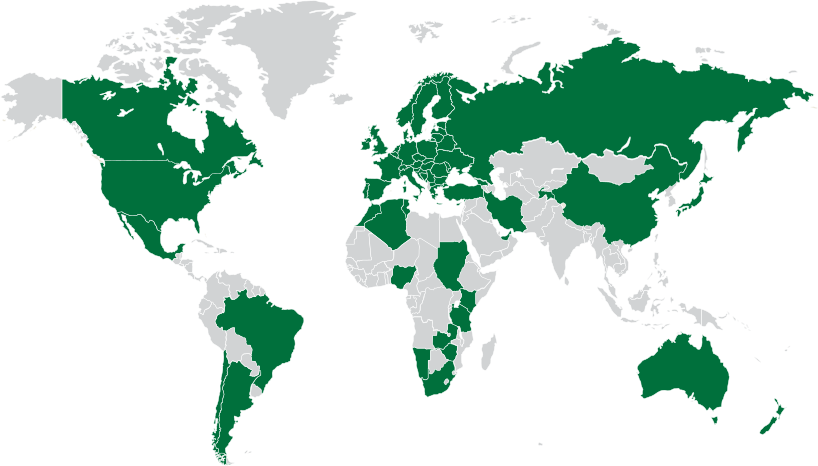
The CIC is a politically independent advisory body that promotes sustainable use of wildlife resources. Established over 80 years ago, the CIC is legally registered in Austria as an international non-governmental and non-profit organization, working in the public interest. The CIC is unique in that it unites 32 state governments as members, along with universities, associations and private individuals. Membership currently spans 84 countries around the world.


The Wildlife Management Education Network is a joint initiative of the two institutions, and aims to develop a network of universities and academic bodies for the advancement of hunting and game management around the world. The launch of the new Masters Degree program is the first step in the development of the Network.


Admission to the 2009 program is currently open and interested students may apply to the University. More information can be found at the web site of the Institute for Wildlife Conservation (http://www.vmi.info.hu/eng/).


CIC Wildlife Management Education Network


The project Wildlife Management Education Network was started at the CIC symposium preceding the 49th General Assembly in Istanbul, Turkey under the motto “ Bridging Continents for Wildlife Management Education”.


The decision to support Wildlife Management Education was made at the EC meeting in Zagreb in November 2001 to develop a new CIC Coordination for International Wildlife Management Education, after the success in reaching a consensus with the Istanbul University to establish a Wildlife Management Education Department within the Faculty of Forestry.


The first step to realize the aims of the project was the symposium on “Wildlife Management Education” organised with the University of Istanbul on 1 May 2002, with presentations made by the heads of wildlife management departments of various universities in world.


The one full-day symposium was a load of knowledge and experience transfer on wildlife management education for all participants, for our university academicians of the newly formed department, as well as for the executives and personnel of the State’s General Directorate of Game and Wildlife of Turkey.


Support also came from the United States, whom we were honoured to have as observers from the Safari Club International. The President Elect Mr. Gary Bogner, with Vice Presidents Mr. Bill Scoble and Mr. John Monson, as well as Mr. John Jackson former President of SCI and President of Conservation Force, and Dr. Bill Wall, Senior Scientist of SCI all claimed that together we will be working our ways to collaborate on this education issue.


The following lectures were delivered at the symposium:


  • Prof. Dr. Ryszard Dzieciolowski (Poland): Programmes and Organisation of Wildlife Management Education in Poland
  • Prof. Dr. Sandor Csányi (Hungary): Training Wildlife Management Professionals for the 21st Century: Learning from International Trends
  • Prof. Dr. Uçkun Geray & Dr. Memduh Iğırcık (Turkey): Game and Wildlife Education in Turkey
  • Prof. Dr. Sandor Faragó (Hungary): Education of Wildlife Management at the University of West Hungary
  • Prof. Dr. Wouter van Hoven (South Africa): New Approaches to Wildlife Management in Africa
  • Prof. Dr. Totul Mol (Turkey): History in Game Hunting in Turkey: Priorities in Wildlife Management
  • Prof. Dr. Vladislav Melnikov (Russia) Game and Wildlife Management in Russia
  • Asst. Prof. Dr. Aynur Aydın Coşkun (Turkey): The Place and Importance of Law in Wildlife Management
  • Prof. Dr. Josef Hromas (Czech Republic): Education of Hunters and Game Managers in the Czech Republic


Excellence in Wildlife Management Education Award

The CIC Executive Committee endorsed a new award in 2002 for special achievements in the field and with the title of “Excellence in Wildlife Management Education.


The new award will be given each year at the General Assembly of the CIC.


A jury of five will be appointed by the Executive Committee and will select the winner among the candidates with extraordinary achievements in the field of wildlife management education.


Nominees are requested to send their documentation to the CIC Budapest Office in any of the three official languages of the CIC (English, French or German).


The Evolution of CITES - 9th edition - 2011


Dedicated to the People and Wildlife of Africa