
A Study on European Hunting Seasons
Description and method of the project
A research project took place in June and July 2009 in the CIC Administrative Office in order to compile a collection of the hunting seasons of mammals in the individual European countries. As similar compilations had not existed until then or respective data had been antiquated, this research was done primarily to provide it to members of the CIC and professional circles interested in the topic.
Previous findings provided by FACE were taken into consideration and extended with an intensive research on the Internet to obtain current data on the national and regional hunting seasons of the individual states. The necessary information was provided by the responsible public authorities or the specific hunting associations. In cases where the access to information on the Internet was limited the hunting associations and national authorities were contacted directly. At the end of the study, further support was received from Cy Griffin from FACE.
Results
The data was primarily compiled by countries (available in German and English) and secondly transferred into charts arranged by species (available in English). You are invited to check out the detailed charts and survey results below.
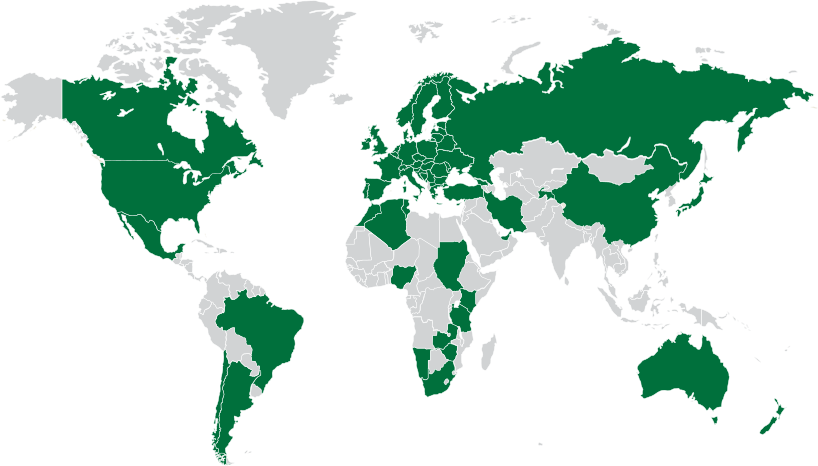
The findings allow the possibility of an international overview and an international comparability for hunting seasons of mammals. So far the hunting seasons of 29 states could be obtained and displayed graphically. In the case of some states due to the high complexity of the hunting season rules web links had to be inserted, which guide the reader to the respective regulations.
General remarks and conclusions
The research on hunting seasons in the different states was not easy at all. Whereas some hunting associations and public authorities made the required facts easily accessible in several languages, this was, despite long research, not the case in a large number of other states. Interestingly the latter was the case especially in the so-called “hunting countries”. This sadly complicates the access to information for potential hunting guests who want to get reliable data beyond the information provided by hunting outfitters and their hunting friends.
Also it was difficult to interpret the annual reassessments of hunting seasons in certain countries. The latest official version often cannot be found without high expenditure of time, while outdated information is still accessible.
Furthermore, in many states the “jungle” of data is thickened by a broad spectrum of regional, highly different hunting seasons and exceptional rules installed due to different political frameworks or to highly varying ecological conditions. Thus, the research showed that there were 40 different mammalian species, which had hunting seasons in the reviewed states. Besides the well-known, “typical”, huntable game as red deer, roe deer and wild boar, also species as the brown bear, marmot, lynx and wild yak are huntable in some states. This variety is often not covered enough by public reports. Additionally it demonstrates that in some European states sustainable wildlife management is definitely possible for specific game species, which are treated as “taboos” in other countries.
Another finding of the survey is a strong variation in the number of huntable species in the different countries. For instance, at the time of the inquiry the Netherlands had hunting seasons for only 2 mammalian species while in Austria the number was 24. Without a doubt, such variation within Europe can often be traced back to the difference in the occurrence of wild animals, though in some cases it has to be seen as a result of the local political decision-making processes fostered by strong resentments towards hunting.
Further conclusions from the comparison of hunting seasons
Already in 2008 an inquiry was presented at the 4th symposium on red deer of the “Deutsche Wildtier Stiftung” (cf. proceedings “’Jagdfrei‘ für den Rothirsch!”) demonstrating the significant differences in the length of hunting seasons for red deer in Europe. Also similar findings were applicable for other game species, like roe deer or fallow deer.
Striking is also the fact that the differentiation of age groups is varying greatly from state to state, whereas the so-called “hunting countries” often showed a relative simplicity in classification. These disparities underline the different values and thus, different priorities of the European countries regarding individual game species. Here, a change in the hunting culture, for example from a traditionally strong management and hunting of small game to a one-sided concentration on big game, could be noted in specific states. This may be dangerous for certain game species, which would fall prey to neglect. It may also have considerable negative effects on the variety of game species resulting from lack of promotion and research.
Proposals for continuation
For the sake of the timeliness and reliability of the gathered data, it will be necessary to regularly update the tables and include eventually changes that may occur due to the amendment of national regulations or the already mentioned annual national reassessment of the hunting seasons. The geographic expansion of the collection towards the Balkan region or the Caucasus region could also give helpful supplemental awareness. The assessed data could be an indicator for the implementation of adequate management measures. First attempts to gather data from these regions showed that there are still huge difficulties, especially in respect of availability of information and language. Based on this hunting season survey, which is aimed to be as broad as possible, continuative comparisons between countries can be taken further, including additional criteria like population numbers and bag statistics, as collected e.g. for game birds within the framework of the ARTEMIS project, ran by FACE. The CIC Administrative Office welcomes other interns to continue to work on the expansion of this survey.
The CIC does not assume any liability for the accuracy of the gathered data on closed and open hunting seasons, and recommends the examination of the respective State law.
| Hunting seasons per regions |
| Hunting seasons per species |